
Smile Enhancement Composite Bonding Veneers: A Case Of Discolored Centrals
Composite bonding veneers for discolored front teeth in Maspeth, Queens, focused on shade matching, contour control, and natural smile-zone esthetics.
Composite Bonding Veneers For Discolored Front Teeth
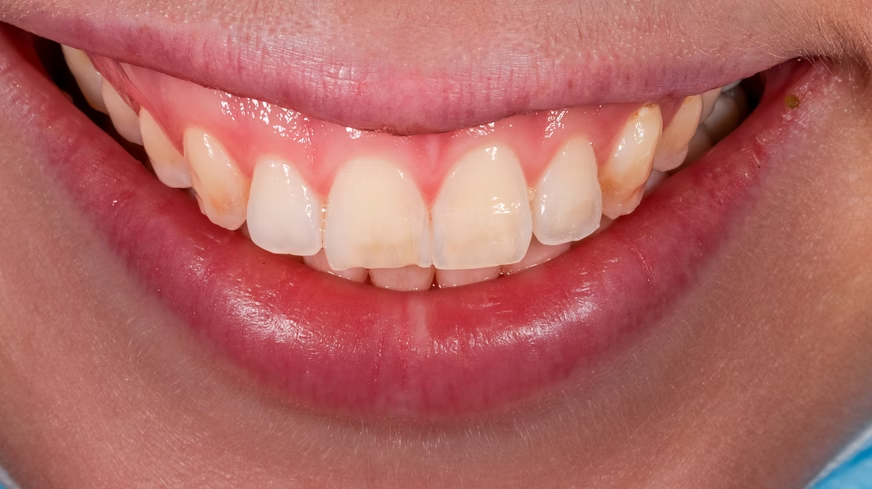
This case shows veneer-style composite bonding for discolored front teeth, with the treatment planned around shade integration and natural smile-zone symmetry. At SOL Dental Arts in Maspeth, Queens, these cases are approached with attention to both esthetics and preservation of healthy tooth structure.
Front-tooth color correction is demanding because even small differences in opacity, contour, or surface texture can be noticeable. The goal is a result that improves the dark or mismatched teeth while still blending into the patient’s natural smile.
A single discolored front tooth can stand out immediately because the eye naturally focuses on the center of the smile. This indirect veneer case at SOL Dental Arts in Maspeth, Queens is designed to improve the appearance of one dark or mismatched tooth while maintaining harmony with the adjacent teeth. Single-tooth esthetic dentistry requires especially careful shade planning, contour control, and material selection so the result blends naturally instead of appearing flat or artificial.
An indirect veneer can be an effective option when the goal is a refined, stable, and lifelike correction of one discolored tooth in the smile zone.
What Was Done?
- Evaluation of single-tooth discoloration
- Indirect veneer treatment planning
- Shade and contour integration with adjacent teeth
- Final esthetic refinement
How We Do It
When one front tooth is significantly darker or different in appearance, an indirect veneer can provide a controlled esthetic correction with strong blending potential.
Frequently Asked Questions
Why Would Front Teeth Need Veneer-Style Bonding?
Front teeth may need esthetic treatment when discoloration, old bonding, shape differences, or trauma make them stand out from the rest of the smile.
Is Matching Front Teeth Difficult?
Yes. Smile-zone cases require careful shade selection, translucency control, surface texture, and contour planning because asymmetry is easy to notice.
Can Composite Bonding Veneers Look Natural?
They can look very natural when the case is selected well, and the material is shaped and polished to blend with neighboring teeth.
Is This Always The Right Option For Discolored Teeth?
Not always. Some teeth may need whitening, porcelain veneers, crowns, or other treatment depending on the cause of discoloration and the amount of tooth structure remaining.

Related Treatment Resources
For treatment context, explore composite bonding, porcelain veneers, composite veneer for a discolored front tooth, and composite bonding vs porcelain veneers.
Ask About A Similar Result
Every smile and treatment plan is individual. Meet our dentists or request an appointment to discuss what may be appropriate for you. You can also call our office. Individual results vary.
Etiology Diagnostics & Color Masking Protocols
Deep intrinsic discoloration in central incisors often presents a unique clinical challenge, as the dark underlying dentin can bleed through thin aesthetic restorations. Discoloration usually stems from prior trauma, nerve space calcification, or age-related dentin darkening. Masking this deep staining without over-building the tooth requires a structured diagnostic plan and an understanding of light refraction.
At SOL Dental Arts in Maspeth, NY, our diagnostic protocol begins with high-resolution digital photography, shade mapping under polarized light, and low-dose digital x-rays. By thoroughly inspecting root health, bone levels, and pulpal stability before treatment begins, our doctors ensure the discolored tooth is biologically sound. This diagnostic step allows our team to formulate a precise resin-layering sequence that blocks dark hues while maintaining a thin, natural tooth profile.

Essential Diagnostic Priorities For Discolored Central Incisors
- Reviewing low-dose digital x-rays to verify root canal health and rule out internal or external root resorption
- Assessing underlying dentin chroma to choose specialized color-neutralizing opaquers
- Mapping incisal translucency and halo effects from neighboring teeth to replicate natural optics
- Checking biting movements and jaw guidance to protect the composite veneer margins from shear stress

Advanced Micro-Layering & Same-Day Polish
Recreating natural central incisor aesthetics with direct or indirect composite veneers requires hand-layering technique and precise material manipulation. Natural enamel is not a uniform block of white; it combines dense dentin opacity with light-refracting translucent borders. Applying a single composite shade over dark enamel yields a flat, dull appearance that looks artificial under natural lighting.
During your visit to our practice in Maspeth, NY, our team hand-sculpts high-density nano-hybrid composite resins in micro-layers. Ultra-thin dentin opaquers mask internal dark spots first, followed by custom-blended enamel shades that recreate lifelike depth and incisal light reflection. Using fine diamond burs and multi-stage polishing pastes, our team creates an ultra-smooth, mirror-like finish that glides comfortably against your lips and resists daily food staining.
Home Care Guidelines For Composite Veneers
- Brush twice daily with a soft-bristled toothbrush and non-abrasive fluoride toothpaste to maintain surface polish
- Floss daily around veneer margins using gentle, curved movements to keep surrounding gums healthy
- Refrain from using front teeth to bite fingernails, open packaging, or crunch hard ice and candy
- Wear a custom-fitted laboratory nightguard during sleep if you exhibit signs of nighttime teeth grinding or clenching
- Schedule regular professional check-ups so our team can evaluate bond integrity, check tissue health, and repolish composite surfaces